Why I'm Writing Again
This article was originally published on Bobby's Substack - you can subscribe for free to be alerted whenever he publishes something new!
I used to write a lot.
Back then it was all swing mechanics and hitting. The deep, technical stuff.
For 10 years starting in 2009, I wrote over 1,000 articles, published 2 books and had a website called Hitting Daily that forced me to write every day.
I built a clientele of professional hitters, had a training facility and spent thousands and thousands of hours working with players to make them better.
My approach was always the same: understand, don’t invent.
Writing was a way to force clarity and share ideas. I wanted to understand what the best players in the world actually do, and why.
Publishing what I was learning online attracted clients from all over. This was before the “Swing Revolution” drifted into worshipping launch angle and exit velocity. Back when video first became accessible enough to see plainly that traditional coaching didn’t match how the best hitters in the world actually moved.
My first book was all about that: how movement impacts timing and creates bat path.
It felt new, but I wasn’t trying to be different. I was trying to understand and share.
So when I eventually stepped away from working with hitters, the writing stopped too.
It wasn’t that I had nothing left to say. It was that the writing had always pulled players toward me, and the whole point of what I was building next was to help coaches and organizations, not to personally be working with players in the batting cage.
I’ll be honest about the fuel underneath chasing better information and coaching.
I never made the major leagues as a player, and part of me was still chasing that. Looking for validation. Wanting to be the guy who worked with the best.

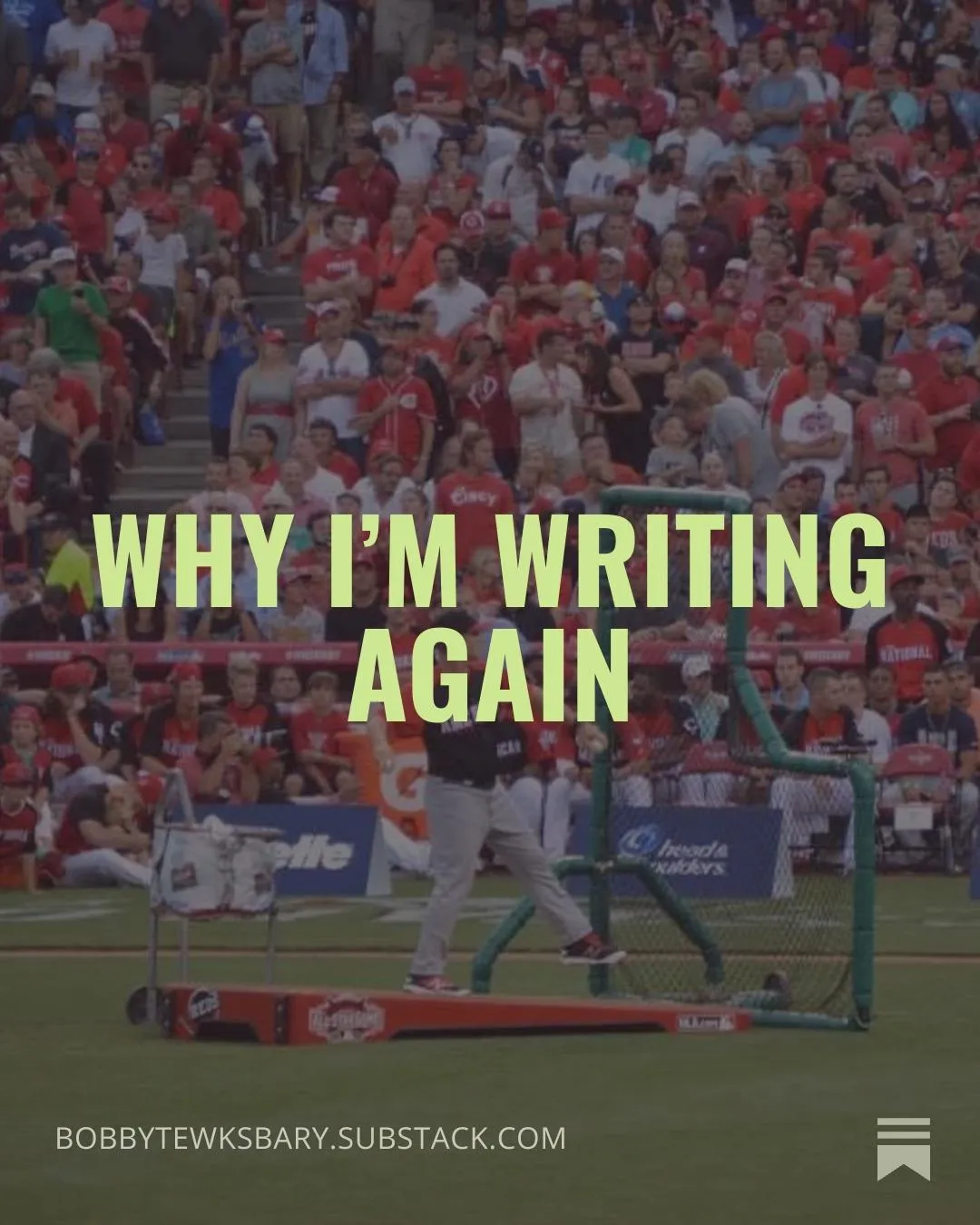
In 2015, I threw to one of my hitters in the MLB Home Run Derby.
I woke up the next morning to over 700 emails from people who wanted to work with me.
That morning changed everything.
Just not in the way you’d think.
The validation I’d spent years chasing showed up overnight. And it felt strange. Almost hollow.
Before the Derby, people challenged me every single day. They pushed back on my information, made me defend it, made me sharper.
The morning after, almost nobody did.
Same approach, same obsession with understanding. But the whole vibe shifted.
And that’s when two problems hit me at once.
The first was practical.
I couldn’t work with 700 people. I didn’t have a system or a model to handle that kind of demand, and no matter how much effort I poured into responding, people got frustrated with me.
It was the first time I felt in my gut that I needed a tool to scale what I was learning. Grinding out nights and weekends in a cage was never going to allow me to service this demand.
I’d already spent years using technology to help hitters. Standing there in 2015, I could finally see the vision: if we collected the right data, we could help players at a scale in ways that no single coach ever could.
That was the seed of Pelotero - the software company I co-founded in 2020 that has built awesome Player Intelligence tools to help coaches and hitters.
The second problem was deeper.
My whole coaching style was relational. I invested in players as people and taught them to understand their own swing so they could own it.
But the new wave didn’t want to understand. They wanted me to just hand them the answer, and they assumed that having it was the same as earning it.
It isn’t.
They wanted me to provide them with being good.
And that was the exact same disease I was already watching spread through the amateur game. Better teams, better coaches, better bats, better everything… except actually becoming better.
By 2016, I was done coaching teams.

The tournaments kept getting more expensive and somehow worse every year. Teams manipulated the rules to squeeze out wins, and the actual play on the field mattered less and less.
Umpires were in a race to get off the field. Parents paid to watch games they paid for their kids to play in. Game rules were designed to squeeze in games, not develop players.
It had become a game run by adults gaming a system. The kids were almost beside the point.
A few of those weekends bothered me enough to walk away for good. (And that was 10 years ago - it has only gotten worse!)
Then, in 2017, my first daughter was born. Everything converged.

The passion I’d poured into other people’s development went straight to my own kids. The lifestyle I’d built (nights, weekends, endless cage hours) stopped being something I was willing to give.
My quest for validation was over.
And the problems I’d been seeing in the game weighed on me far more than any single swing ever could.
I lost interest in fixing one swing at a time, because I could finally see the bigger problem. And it wasn’t any hitter’s mechanics.
It was the whole system.
What I’m helping build now isn’t about me reaching the top. It’s about giving something back to the game and building a better experience for the kids coming up.
That’s a different problem. And a better one.
In 2020, I went all in, dedicating myself to building a company that could scale great coaching instead of delivering it one cage session at a time. (I still work on hitting every single day; the delivery method is just entirely different now.)
Then, a little over two years ago, after years of building and planning, it finally clicked.
The unlock wasn’t a sharper metric or a slicker app. It was a completely different way to organize the entire game.
That single shift is the foundation of everything I’m going to write about here.
What the Broken System Actually Looks Like
Let me tell you what that broken system looks like up close. Because I live in it.
Some of my closest friends are coaches who run teams and training facilities.
It’s a brutal business with long hours, thin margins and a model that punishes the people who care the most.
To keep the lights on, most of them have had to play a game they don’t even believe in.
They’re not villains. They’re trapped.
Complicity is a survival requirement in this industry.
Travel ball exploded out of the same chase I felt the morning after the Derby: the chase for the label of good.
The age-based model became incredible easy to exploit. Stack a roster with the biggest, most physically mature kids, win a pile of tournaments and suddenly you look like a great program.
It became a rat race. An endless need to prove your worthiness to parents and players, measured by all the wrong things.
And the squeeze is only getting tighter.
The transfer portal and NIL have turned college rosters into a churning marketplace, where seasoned veterans take the spots freshmen used to earn. The MLB draft is shorter than it has ever been.
There are more players chasing fewer real opportunities than at any point in the game’s history. And all of that pressure rolls downhill onto kids who are far too young to carry it.
This isn’t a “someday” problem.
If we don’t fix how we organize, develop and evaluate players now, the cost won’t be a lost trophy. It’ll be a generation of burned-out kids who not only quit a game they could have loved, but also resent the game.
And the people caught in the middle are the parents. They have no way to see through any of it.
They’re drowning in FOMO and doubt. Is my kid on the right team, at the right facility, on the right path? Am I doing enough?
There’s no perspective anywhere, because the entire industry is built on the wrong framework.
Everyone is scrambling to prove they’re “good” inside a broken system. The questions that should matter are: Do you help kids love the game and do you actually make players better?
Those are the questions I want to build everything around.
Here’s what I’ve come to believe.
I love data and technology. I’ve bet my career on them.
But when you get too data-heavy, you lose the nuance of the sport. The cat and mouse, the feel, the human element that made me fall in love with it in the first place.
Numbers should serve the game, not replace it.
So we set out to build something the old model can’t fake: a way to prove you make players better.
A model you can’t hack. One where the only way to be good is to be good against your physical equals.
Because good is earned. Good is relative. Good is hard. It’s supposed to be.
So I’m Back
For years, Pelotero has been about one problem: making hitters better. We build technology to make good coaching scalable, and we deliver it through coaches and organizations rather than working with players directly.
Everything I’ve ever learned about hitting is baked into what we build.
And for all that time, Pelotero has been one thing: a hitting company.
Until now.
Because the longer we built, the more our thinking advanced. We ran into the bigger problem sitting above all of it.
It isn’t enough to make a player better if the entire system around them is organized wrong. The real problem is how players are organized, evaluated, and understood in the first place.
Solving that is a different order of ambition. And arriving there is a big part of why I’m writing again.
A problem this big doesn’t get fixed by a product alone. It gets fixed when enough people decide the old way isn’t good enough.
I’m writing again for the same reason I always did: to share what I’m learning.
What’s changed is the stakes.
Back then I was sharing a better way to swing a bat. Now I’m sharing a better way to organize the whole game.

And this time I’m not looking for clients. I’m looking for a community.
I’m done participating in the broken version. I’d rather build a new one, with the people who feel exactly what I feel.
The whole industry is complaining. Everyone can see it’s broken: the fighting in the stands, the stacked teams, the burned-out kids.
But complaining isn’t a plan. We’re taking action.
We’re building a new option. A new path. One you can actually walk down instead of just shaking your fist at the old one.
So how do you build a model you can’t hack?
It starts with the ability to measure how good a player actually is, rooted in the speed at which they can play the game.
I make the full case in a companion piece, Every Play Is a Race, and it’s the foundation for everything Pelotero is doing.
If you want to understand how we think, start there.
If you’re a parent trying to figure out if your kid is truly on the right path, a coach who wants to build something real, or someone who cares where this sport is headed: this is that place.
Some of it will make people mad.
Good.
Subscribe if you’re done pretending the current model works.
Let’s build the alternative together.