Every Play is a Race
This article was originally published on Bobby's Substack - you can subscribe for free to be alerted whenever he publishes something new!
This is the companion piece to Why I’m Writing Again, the personal story behind everything here. If you want the “why,” start there. This is the “how.”
Baseball and softball are not countdown sports like basketball, football, or soccer.
Outs and innings are the clock. And you have to make plays for the game to end.
You can’t just dribble the ball out like in basketball or take a knee like in football.
That’s a big part of what makes these diamond sports so beautiful.
But what gets lost in the “no clock” part of baseball and softball: the game is incredibly time-based.
How fast you run. How hard you throw. How quick your bat is. How hard you hit the ball.
Every one of those is a measurement of time. The industry is obsessed with metrics. What can we measure? How can we make the numbers improve? But nobody is putting the full story together to clearly define what the data means for players.
Every play is a race. We should be building players who can win those races.
Watch These
Let me show you what I mean. This is a new test we are introducing called a Fielder Pop Time. It is meant to replicate a difficult play.
This is a 12u baseball player and a high school aged college prospect.
This is a 8u softball player and a high school aged college prospect.
It is very obvious that these players are operating at much different speeds. As they should be.
Apply this to pitch velocity. Apply this to a ground ball to shortstop. Apply this to a player stealing second base. Apply this to a double in the gap to right center.
The plays don’t change as you climb the levels. What changes is how fast and how consistently each component happens.
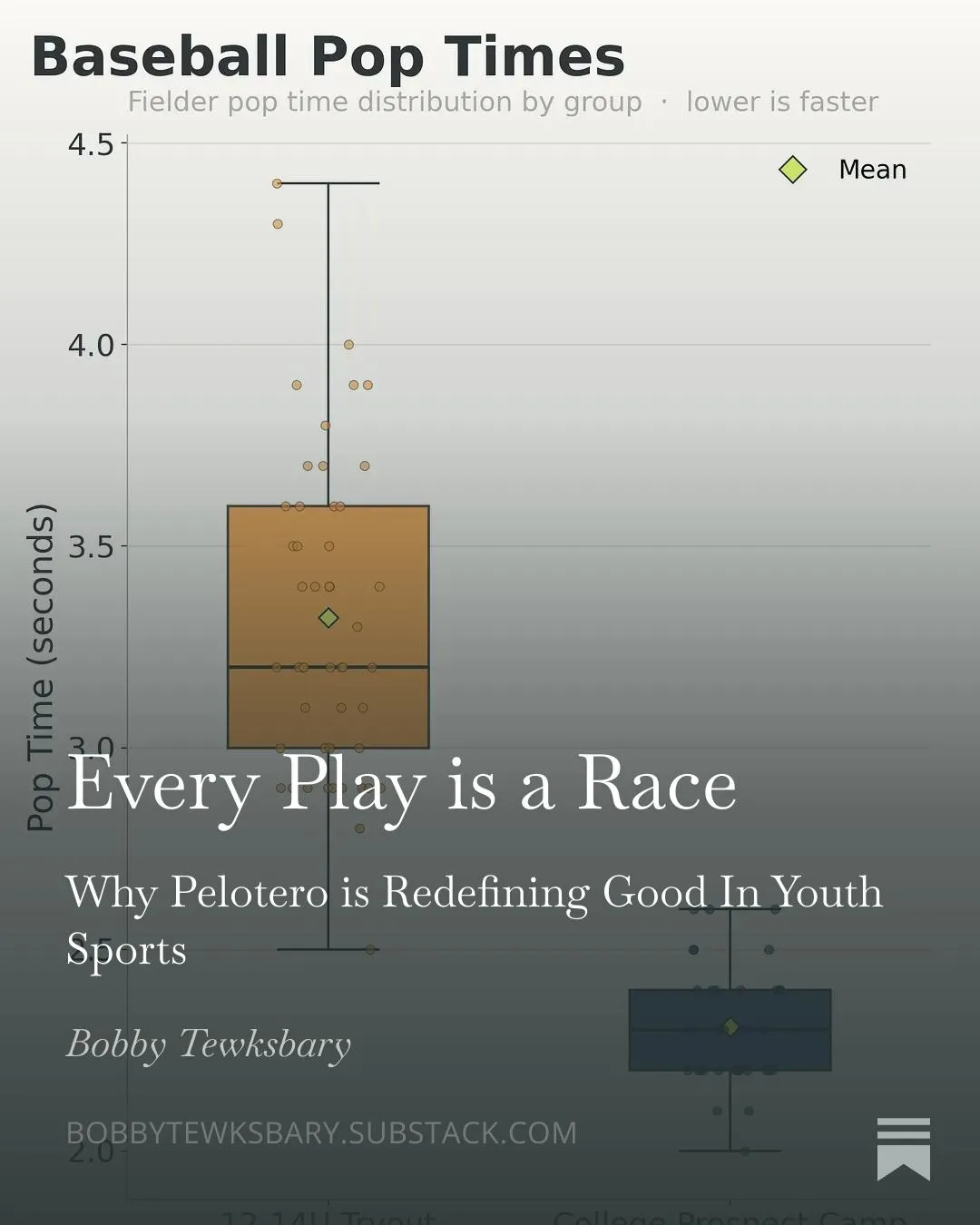
Here’s a bigger breakdown for groups of players - 12-14u tryout compared to an entire prospect camp. If there’s a huge 13 year old who performs at “prospect level” speed (typically 16-18 year-olds), why in the world should they be playing against other 13 year olds?

And here’s a softball breakdown of an 8u team vs a college prospect camp. There are two players who probably (definitely) should not have attended the prospect camp IF getting recruited was a goal of attending.

And now let’s put it into the context of a game by looking at an in-game play compared to the test. This is a college prospect vs. an in-game diving play from by an MLB player.
The diving play is actually a longer throw… but you can see there are levels to this!
What the Difference Means
So what do we do with this? Where can we make improvements to the current development and game play model?
1. Player Evaluation
Assessments should be constrained by time and communicated through the lens of time.
The most common team tryout format we hear about uses a subjective 1-5 rating. That doesn’t make sense.
Collecting metrics is great. But what is more important is how numbers are being used to communicate with parents, organize teams, and identify strengths and weaknesses.
2. Teaching and Training
If the play is a race, you train the parts of the race. Time becomes the framework for everything you train with a crystal clear why.
First-step quickness and footwork gets you to the ball quicker. A cleaner transfer gets the ball in the air faster. Arm strength gets the ball to the target in less time. Better anticipation and faster decisions put you in the best positions to make plays consistently.
3. Organize Competition
When players compete at different paces of play than everyone around them, nothing good happens. When they are way ahead, they’re bored and they are unchallenged. When way behind, they’re buried and discouraged.
Development happens when you’re matched against physical equals. When the play is close. When the race is actually a race.
This creates adaptation and tight feedback loops that help athletes fail forward. (Athletes shouldn’t be failing all the time, but ideally you’d want their experience broken into thirds - 1/3 of the time be an underdog, 1/3 of the time be evenly matched and 1/3 of the time be the favorite.)
4. De-emphasize Winning (Appropriately)
Winning games in an environment that doesn’t challenge you is a waste of time.
A dominant 12-year-old racking up wins against overmatched kids isn’t developing. It is dangerous because the player could be falling in love with winning, not with getting better.
Players should always be competing to win, but the process and effort is way more important than the outcome.
5. Track Progress
Understanding how fast the game is moving at a player’s current level is critical. Creating measures that are standardized and repeatable maintains a strong feedback loop for players, coaches and parents.
So Ask Yourself
Before the next tournament… before the next check you write… before the next trophy goes up on the shelf.
How are you defining success?
How are you measuring good?
Against the kids in the other dugout, who just happen to share a birth year?
Or against the actual demands of the sport?
How often are kids playing in truly close games? There’s a different feel when you know you have to play well to win.
Baseball and softball are time-based games. Every play is a race.